The argument in brief
- The question
- When we write detailed personas, are we designing for the most probable user or for the most vivid one?
- The claim
- Adding detail to a persona makes it feel more likely but can only make it less probable. Improve the experience for a specific subset of users only when it doesn't make things worse for everyone else. Confidence: The probability point is a rule of logic. The design advice is a practical view from my own reasoning, not tested.
- The evidence
- The conjunction rule of probability, as summarised in the Wikipedia article on the conjunction fallacy and the Linda problem.
- An informal Twitter poll I ran in June 2018, in which most respondents chose the more specific answer. A self-selected poll, not a study.
- A figure on shoppers leaving a site to look for a voucher code, which I can't currently verify.
- Daniel Pink's account in When of a time-of-day effect on the Linda problem, and the 1990 study by Galen Bodenhausen behind that kind of finding.
- The best counter
- People may read a question like mine as conversation rather than as probability, taking 'a laptop' to mean 'some laptop other than a MacBook Pro'. And personas are meant as archetypes to build empathy, not as probability statements.
- What would change my mind
- Evidence that teams using detailed personas don't make features that burden the wider user base, or that a voucher field at checkout doesn't send people without a code away.
- Open gaps
- 1 gap. Statements I haven't verified yet. Each is marked in the text.
Falling for the conjunction fallacy
The question: When we write detailed personas, are we designing for the most probable user or for the most vivid one?In a tweet I asked a very specific question to see how easy it is to fall for the conjunction fallacy:
Question. Sam is a developer. They enjoy React.js development, have an iPhone and an iPad. Which is more probable. #webdev #javascript #programming #apple
Limits: This was an informal Twitter poll answered by whoever saw it, mostly people who follow me. It shows how easy the mistake is to make, not how common it is.I set the scene by describing the common traits of a fictional user: a React.js developer who uses Apple products. I then asked a simple question, Which is more probable? Is it that they use a laptop, or that they use a MacBook Pro? The results were in favour of the MacBook Pro … by a lot.
That is the incorrect answer.
Another way of writing this would be:
- Sam uses a laptop
- Sam uses a laptop which is a MacBook Pro
Here, we’ve introduced a conjunction: it’s a laptop and a MacBook Pro, compared to it being just a laptop.
Claim, confidence:follows from the rules of probability: Since the probability of it being both a laptop and a MacBook Pro must be equal to or less than it just being a laptop, the correct answer is that Sam uses a laptop. There is no scenario where Sam uses a MacBook Pro which is not a laptop.
A competing explanation: People may not hear the question as one about probability. In conversation, “a laptop” offered next to “a MacBook Pro” can sound like “some other laptop”, and then choosing the MacBook Pro is a reasonable guess rather than a logical slip.This is a well-known puzzle called the Linda problem, and the rule behind it is summarised as follows:
The probability of two events occurring together (in “conjunction”) is always less than or equal to the probability of either one occurring itself.Source: States the conjunction rule in these words and describes the Linda problem from Tversky and Kahneman, in which most people judged “bank teller and active in the feminist movement” more probable than “bank teller”. An encyclopedia summary, not the original research.Conjunction fallacy, Wikipedia, accessed 26 October 2026
Conjunction fallacy in your personas
Claim, confidence:a working view from my own reasoning: When identifying personas it’s easy to make this assumption about your users and be too specific. Take this example for an online store:
Sam loves shopping online and is always on the hunt for the best bargain. Often checking out voucher sites and Groupon, they love to hunt for the best deal and will often spend more if there’s money off.
An assumption: I am treating the persona as if it were a prediction about who will buy. Most teams intend personas as archetypes to build empathy, not as probability claims, but in practice they often get read as “this is our customer”.Now you’re tasked with designing the checkout process for this online store. Reading that persona, you come to the conclusion that there needs to be a place for a voucher code to be entered during the checkout. You design a nice voucher call-to-action and Sam is super happy.
Here is the conjunction fallacy, so let’s ask, which is more probable?
- Sam will purchase on your online store
- Sam will purchase on your online store and has a voucher code
The persona suggests the latter, but what you’ve successfully done is create a complication for the set of users who don’t have a voucher code. Unverified: Studies have shown that up to 27% of people would exit your site and go searching for a voucher code.Gap · unchecked figure: My original cited an eMarketer article, The Sad Tale of Abandoned Shopping Carts, which I can no longer open. The closest figure I can check is a 2009 PayPal survey reported by ChannelX, in which 25% of people who abandoned a checkout said they left to look for a coupon or voucher. That is a share of abandoners, not of all shoppers.
Be specific, but not at the detriment of others
What would change my mind?: Evidence that a visible voucher field doesn’t send people without a code away, or that teams working from detailed personas don’t end up burdening their wider audience.In conclusion, you want to be aware of how true and probable your personas are. Claim, confidence:a practical principle, not tested: It’s okay to improve the experience for a subset of users (those who have voucher codes), so long as it isn’t to the detriment of the superset (anyone buying on your site).
Timing is everything
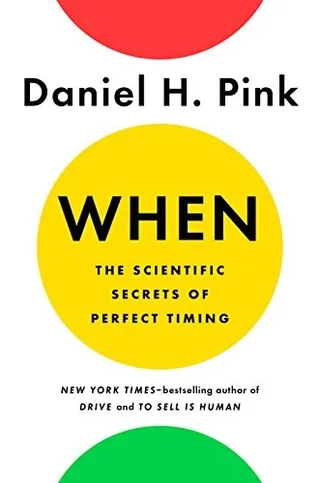
Limits: The well-known experiment Pink describes compared 9 a.m. with 8 p.m., not morning with afternoon. Bodenhausen’s study found the effect depends on the person: “morning people” did worse in the evening, and “night people” did worse in the morning. So the fuller advice is to design them at your best time of day.I discovered the Linda problem reading When: The Scientific Secrets of Perfect Timing by Daniel Pink. It turns out that people are more vulnerable to the conjunction fallacy in the afternoon than in the morning.Source: An extract from When, published by Riverhead Books. It says researchers have posed the Linda problem at different times of day, including 9 a.m. and 8 p.m. in one well-known experiment, and that people were much more likely to get it right earlier in the day, with one exception the book discusses later.Perfect Timing (extract from When), Daniel H. Pink, via Outlook Business, 2018Source: Two studies. Participants showed more stereotype-driven bias, including in probability judgments, at their less alert time of day: the morning for night people and the evening for morning people. I have read the abstract, not the full paper.Stereotypes as judgmental heuristics: Evidence of circadian variations in discrimination, Galen V. Bodenhausen, Psychological Science 1(5), 319–322, 1990
My advice: design your personas in the morning.
Sources
- Conjunction fallacy, Wikipedia, accessed 26 October 2026
- Perfect Timing (extract from When), Daniel H. Pink, via Outlook Business, 2018
- Stereotypes as judgmental heuristics: Evidence of circadian variations in discrimination, Galen V. Bodenhausen, Psychological Science 1(5), 319–322, 1990
Books behind this essay
Not sources for any claim here. These are books I have finished that shaped how I think about this question. Where I rely on evidence, it is cited in the text.
When (opens audible.co.uk, external site)
Shaped how I think about time of day as a factor in judgement, and it is where I first came across the Linda problem.
Critical Thinking In A Nutshell
Shaped how I think about spotting reasoning errors like this one in everyday decisions.
Inspired (opens audible.co.uk, external site)
Shaped how I think about building products for the customers you actually have rather than the ones you imagine.
The Mom Test (opens audible.co.uk, external site)
Shaped how I think about checking assumptions about users against what they actually do.