The argument in brief
- The question
- Can we change how we feel by talking to the instinctive, emotional part of ourselves?
- The claim
- The emotional, instinctive part of us and the thinking, language-using part are different, and by recognising that we can talk to ourselves in a way that changes our mood and how we act. Confidence: A personal reflection from my own experience. The model of the mind is my summary of Steve Peters's, and the brain claims in it are unchecked.
- The evidence
- My own experience of getting out of bed at 5am when I was busy negotiating to stay there, and of calming myself by talking to my sasquatch.
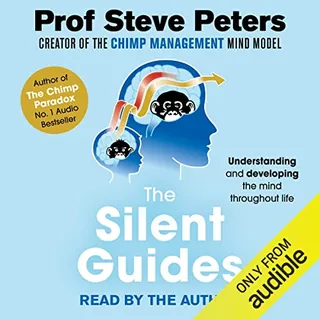
- My reading of The Silent Guides by Professor Steve Peters and its chimp, human and computer model of the mind. I don't cite it for any specific finding.
- One observation of a father and child in a public restroom, and my guess at why the child was upset.
- No studies cited.
- The best counter
- The chimp, human and computer model is a helpful metaphor, not a map of the brain. Emotion and reasoning are closely intertwined, and what feels like talking to another part of me may simply be thinking in a calmer way.
- What would change my mind
- If talking to myself like this made no difference to how I felt once I stopped expecting it to, or if the evidence showed that emotional memories don't form the way this model suggests.
- Open gaps
- 4 gaps. Statements I haven't verified yet. Each is marked in the text.
The question: Can we change how we feel by talking to the instinctive, emotional part of ourselves?I’m lying in bed. It’s 5am. I don’t want to get up. I promised myself I would get a head start on the day for my own projects. But I lie there. I’m thinking of reasons why I shouldn’t get up. I don’t want to get up.
Suddenly, my body takes over and I sit up. Just the push I needed to take action. But how did that happen? I was busy negotiating to stay in bed. Who took over?
It was at this moment I realised the full potential of our inner Sasquatch. The lovable teammate we all live with. There to protect us. There to feel for us. There to take action when we most need it.
The sasquatch
I don’t know how I named it the Sasquatch. But it refers to Unverified: the chimp part of our brain that controls our instincts, emotions and fight or flight response.Gap · needs evidence: This is how I understood the model, not something I've checked. Instincts, emotions and the fight or flight response aren't the work of one tidy part of the brain. But I feel it’s much more than that. I feel you can talk to it.
In the book The Silent Guides, Professor Steve Peters introduces us to the concept of the Chimp mind, the Human mind and the Computer mind.
This specific book was written to help parents understand their developing child. Why they get upset, but can’t tell you why. How their emotions get encoded. And why they seemingly fail to have spatial awareness.
Interestingly, I found the book much better at allowing me to understand myself. It also helped me to better understand other adults.
The architect
This is the part of the brain that we often think of as “ourselves”. It’s the part where we think. Unverified: Assuming you don’t experience aphasia, it’s the part of our brain that thinks in language.Gap · needs evidence: I haven't checked how language maps onto the brain, or what aphasia does and doesn't affect. This is my simplification.
You can talk to yourself. You can predict the future by thinking about different possible outcomes. You can make decisions, such as how you should feel about a given situation.
A competing explanation: The chimp, human and computer model is a metaphor for the mind, not a map of the brain. Emotion and reasoning are closely intertwined, and what feels like one part talking to another may simply be me thinking more calmly.Peters refers to this as the Human brain. Unverified: This part of the brain is slower to respond.Gap · needs evidence: This is my summary of the model; I haven't checked the claim that this part of the brain is slower to respond against any research. But given enough time, it can help you change how your chimp brain responds by giving it the right information to make emotional decisions.
If you have the ability to control how your emotions respond, then I feel that makes you the architect.
Storing emotions
This leaves the Computer part of the brain, where our memories are stored. As a child, you might experience things, but haven’t fully developed the human part of the brain. Unverified: If those experiences produce emotions, they (the emotions) get stored in the computer part of the brain. But not the reason why: that requires a human brain to do so.Gap · needs evidence: This is how I understood the model. I haven't checked what is known about how children's emotional memories form, or whether the reason is lost in this way.
So a child will get upset by seemingly simple things by their chimp brain. A parent will wonder why and will ask the child. The child, who only knows they should be upset, doesn’t know why. Their reasoning wasn’t encoded in the memory because they lacked the ability to do so.
Limits: This is one moment I saw from the outside, with a stranger I didn’t speak to. My explanation is a guess, and I can’t know what was really going on for the child or his father.I’ve seen this play out. In a public restroom, I witnessed a father with his son. The father asked the child to wash his hands. The child starts crying and refuses. The father thinks he’s just “being a baby”. What the father doesn’t know is that the child has an encoded bad emotion associated with hand washing in public restrooms, but cannot tell him why. My logical guess would be the loud noise of the hand dryer upsetting him when he was younger.
Talk to your sasquatch
Sometimes when I feel overwhelmed, I talk to my sasquatch. He doesn’t reply using words, but can give me images of thoughts. Observing the separation of your words and your ideas helps you spot where your emotions are in control.
Sometimes I find it soothing to say that everything will be okay. Just relax and things will calm down. My sasquatch listens. My mood can change. Simply recognising it can be enough to break the emotional loop.
At the end of the day, you’re a team. An evolutionary trick to have an instinctive part of the brain to make quick decisions to survive. But also a logical part of the brain that can strategise and plan long term.
We know the brain is a fascinating organ. So let’s use this to our advantage.
I don’t know the depths of this. Ever since I started paying attention to my chimp brain I have noticed I can see things at a distance. Talk to it and get a response. A response that changes its mood. And in some cases, a response that gets me out of bed at 5am. Thank you Sasquatch, I owe you one.
The ah-ha moment
Knowing about the parts of our brain can be a huge benefit when we learn why it does what it does. Taking this to advanced levels, we can work on becoming the architect of how we want to feel and act. Claim, confidence:a personal reflection from my own experience: By recognising that our language and emotional parts of the brain are different, we can start to talk to ourselves to feel loved, secure and appreciated. It’s hard to explain, but I believe there’s something remarkable to discover.
And if you listen closely, your Sasquatch will talk to you. A random thought injected, a cheeky idea, a physical dance. That’s it saying hello.
Books behind this essay
Not sources for any claim here. These are books I have finished that shaped how I think about this question. Where I rely on evidence, it is cited in the text.
The Silent Guides (opens audible.co.uk, external site)
Shaped how I think about the chimp, human and computer parts of the mind, which this piece is built on.
Master Your Emotions (opens audible.co.uk, external site)
Shaped how I think about noticing my emotions and choosing how to respond to them.
The Happy Brain (opens audible.co.uk, external site)
Shaped how I think about how hard it is to tie what we feel to particular parts of the brain.
The Craving Mind (opens audible.co.uk, external site)
Shaped how I think about emotional loops, and how simply noticing one can help to break it.