The argument in brief
- The question
- If I don't bring resources to a conversation, what is it that I do bring, and how do I describe it?
- The claim
- Most people engage with others through resources such as money, status, power and network. I trade on ideas, and my ideas are rooted in building systems that work towards a goal. Naming that is the first step to communicating it. Confidence: A personal reflection. It rests on my own experience, one passage in a book and one leadership assessment.
- The evidence
- My own experience of mentoring, winning UX work and being offered business partnerships after a conversation.
- The Innovator's DNA, whose authors distinguish networking for ideas from networking for resources. I have checked their own summary article, not the exact wording in the book.
- A leadership assessment through my work that described my personality as a Quality Architect.
- The best counter
- The small talk and resource trading I find boring may be how trust gets built, and that trust may be what lets people open up to a conversation about ideas at all.
- What would change my mind
- If people who open with ideas, rather than resources or rapport, turned out to be no more able to help others, or if my strengths in conversation showed up just as clearly without any of the systems framing.
- Open gaps
- 1 gap. Statements I haven't verified yet. Each is marked in the text.
The question: If I don’t bring resources to a conversation, what is it that I do bring, and how do I describe it?I’ve struggled for years to have deep, meaningful conversations with people where I can see their challenges from afar, but feel compelled to help. I dunno, maybe it’s part of my ‘pay it forward’ philosophy, or it’s that I genuinely enjoy it and feel I can learn more along the way.
But I don’t have resources that people can tap into, so they’re not interested. I don’t offer opportunity, nor do I offer connections, and I rarely like to put my reputation on the line for others. What I offer is private, behind closed doors, but ever so valuable.
This is true of both personal and business relationships. The magic happens when we jump into a conversation, forget the preamble, and roll up our sleeves and dive in. That’s when the other person realises what I do, even if they don’t know how to put words to it.
I’ve been privileged to mentor a select few, won UX gigs after ‘having a conversation’ and been offered the ability to partner in businesses as a result of this. But up until now, I didn’t know how to describe what it is, which means I’ve not been able to help as many people along the way.
“Alright Martin, stop bragging”
I know, writing that feels like I’m bragging, but really it’s a way for me to express the experience and problem I’m trying to solve.
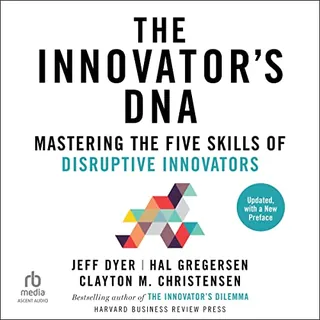
The Innovator’s DNA
So I was reading the book The Innovator’s DNA by Jeff Dyer, Hal Gregersen, and Clayton M. Christensen and there was a part that jumped out.
Unverified: They were saying that most people trade on resources (money, status, power, network), that type of thing.Gap · needs evidence: I'm paraphrasing the book from memory. I haven't checked its exact wording, or whether the list of money, status, power and network is the authors' or my own. They like to engage with others using these resources. I see it so clearly in my profession. The people you know, the things you do, the opportunity you present. People treat CEOs much more differently than lower level employees. Why? Because they have so many more resources than the employee.
If you think about networking, it’s a combination of holding opportunity (resource to purchase, or use your reputation) as leverage in the discussion. See anyone nearing retirement who worked like this and it’s filled with stories of different people through the industry. They’re flexing their network muscles. That’s capital they use to trade within the conversation.
A competing explanation: The small talk and resource trading I find boring may be how trust is built. People may need that trust before they will open up about an idea, so it could be a step towards the conversation I want rather than a substitute for it.Me however. I don’t engage. It’s boring. And I always knew it. But when I read in The Innovator’s DNA that innovators trade on ideas, not resources, I had my ah-ha moment.Source: The authors’ own summary of the book. In its section on networking it distinguishes innovators, who search for new ideas by talking to people with radically different views, from networking for resources. “Trade on ideas” is my wording.The Innovator's DNA: Five Skills to Develop Your Creativity, Jeff Dyer, Hal B. Gregersen and Clayton M. Christensen, BYU Marriott Alumni Magazine, Winter 2012
I’ve always wanted to have deep meaningful conversations about ideas. I’m sorry, I’m not as interested in your family, your pets, or what your neighbour said. That’s just the way I’m wired.
Describing what I do
So trying to get past the superficial introduction when meeting new people is hard. Because I’m trying to describe what I do, not because I have resources to offer you, but I want you to open up so I can show you what I do. I’ve noticed most people are guarded because they just don’t get it. And alas, a great opportunity passes on by.
Limits: This rests on a single assessment and my own sense of how my conversations go. A personality label describes a tendency; it doesn’t show that the conversations actually help the other person.In a recent leadership assessment through my work, I discovered that my personality aligns with being a Quality Architect. What this means in practice is that I like to spot the processes that drive success, I have pretty high standards (in a growth mindset type of way), and I understand risk mitigation and have a very methodical and practical approach.
So when I have a conversation with someone, I’m laying a foundation to understand what they mean. I’ll ask probing questions when there are gaps in this foundation. I’ll help bridge those gaps and I’ll spot insights that are often missed.
In some respects, I like to spot the unspottable, see things from both the ground level and the 50,000 ft level in an instant. I like to stress test ideas so we understand the mechanics. All this is with goal alignment to figure out how to make it happen. It’s pure idea exploration through the lens of a systems builder.
What disappoints me most
Honestly, the most disappointing part of having a talent that I just want to share is that I struggle to pitch it. There have been many online acquaintances who have passed over my offer to help (by help, I mean just have a chat to see if they like what I have to say). I even offered my help to Ali Abdaal’s team surrounding an app they were working on while at one of the Part Time YouTuber Academy (PTYA) meet-ups. (See what I did there, I tried slipping in some reputational capital into this story.)
But what is exciting
Having finally connected the dots that Claim, confidence:a personal reflection: I trade on ideas, not resources, and discovering that my ideas are firmly rooted in systems building with a strong emphasis on working towards a goal, I now know what I do.
The next step is to figure out how to communicate this clearly, so others get it, and cut through the confusion and get down to the most exciting part: figuring out the impossible challenge and making the world a better and more enjoyable place.
Sources
- The Innovator's DNA: Five Skills to Develop Your Creativity, Jeff Dyer, Hal B. Gregersen and Clayton M. Christensen, BYU Marriott Alumni Magazine, Winter 2012
Books behind this essay
Not sources for any claim here. These are books I have finished that shaped how I think about this question. Where I rely on evidence, it is cited in the text.
The Innovator's DNA (opens audible.co.uk, external site)
Shaped how I think about the difference between trading on ideas and trading on resources, which is the moment this piece describes.
Thinking in Systems (opens audible.co.uk, external site)
Shaped how I think about looking at a problem as a system, from the ground level and from far above.
Mindset (opens audible.co.uk, external site)
Shaped how I think about holding high standards as a way to grow rather than as a judgement.